The gift.
When something you wanted as a child finds its way back to you, decades later, from the hands of someone you almost gave up on.

I don’t remember the exact day it started, but I remember what it felt like.
Somewhere in the middle of my separation—after the hard conversations but before anything felt resolved—I started to go numb. I didn’t have a suicide note. I didn’t have a plan. But a part of me didn’t want to keep going.
It’s not that I wanted to die. It’s that I didn’t have a picture of what a good life would be to live.
It felt like I had spent my adult life chasing the dreams of my youth—love, family, purpose. And for a while, they buoyed me. I clung to them like a life raft. But when the dream collapsed, it was as if the buoy disappeared—and I was suddenly drowning in the middle of the ocean.
Ty Cutner, an IFS coach I had just started working with, and now a dear friend, gave me a simple but profound invitation:
“Start by remembering the things you used to love when you were a kid. That part of you is still alive. Give it something to hold on to.”
I didn’t know what that meant at first. But I was desperate enough to try.
At first, it felt a little silly.
What did I love as a kid? Not the way adults talk about hobbies, but the stuff that lit me up before I knew anything about bills or broken hearts.
I didn’t have a clear answer. So I started small.
I took my boys to Lagoon—the amusement park in Farmington, Utah. It wasn’t perfect or magical, but it was something. I watched them laugh on the rides, and for a moment I could feel younger parts of me stirring. The part that loved motion and summer and the smell of hot pavement and popcorn. The part that just wanted to be near joy.
I picked up my guitar again. Not to write anything great. Just to remember what it felt like to make sound from silence. I started letting myself play the songs I first heard when I picked up the guitar but didn’t have the skill to learn.
And then, there were the Matchbox cars.
I didn’t talk about them much. It felt almost too tender. But there was something healing about those tiny vehicles. I started collecting replicas of the cars and trucks from the TV shows and movies I loved when I was a single-digit boy.
The A-Team van—with its red stripe and mystery. The Fall Guy truck. The Back to the Future DeLorean.
And maybe most meaningful of all: the black Toyota pickup from the end of Back to the Future—the one Marty finds in the garage after his timeline shifts. The moment where everything is suddenly… better.
These little toys weren’t just nostalgic. They were anchors. Reminders. Invitations.
They helped me remember who I was before I tried to be everything for everyone. Before the dreams. Before the crash. Before I forgot that joy is a compass too.
While I was piecing myself back together, my oldest brother was falling apart.
If you’d asked anyone a few years earlier, he would’ve been the last person you'd expect to see unravel. He’d built a small empire in Idaho—buying up properties when they were still cheap, fixing them up himself, and either flipping them or turning them into long-term rentals and Airbnbs. At one point, he owned seven properties and ran everything himself. He was brilliant in his own way. Independent. Resourceful.
But brilliance doesn’t insulate you from pain.
I don’t know everything that triggered his collapse, but I know it started around the same time as my separation. He was trying to face things—deep, unspoken things—and it felt like they swallowed him.
He started drinking heavily. Maybe using other things too. His emotional world got dark and unpredictable.
I remember one moment clearly. We were playing golf—me, him, and our middle brother, Don. I was in the thick of figuring out my living situation with Sarah, my then-wife, and trying to talk it through. But he snapped. He started yelling at me. Not just annoyed, but furious. That wasn’t like him.
He threatened to walk off the course if we didn’t drop the conversation. So we did. But I remember looking at Don and knowing we were both thinking the same thing: something’s not right.
That was August.
By September, he was talking about visions. He’d gone on a trip with a friend and came back saying he’d met with God, that he had solutions to the world’s problems. It didn’t feel spiritual. It felt manic. Delusional. Grandiose.
And by November, the signs were undeniable.
The power at his house had been shut off. Airbnb had removed his listings after too many complaints. The houses weren’t being cleaned. Guests were showing up to chaos. He was sending hundreds of texts in the middle of the night—long, disjointed streams of thoughts no one could follow.
We tried to help. Tried to get the police to do wellness checks. But every time, he resisted. He’d lash out. Not physically, but with his words—full of fear and fury. It became clear that we couldn’t reach him, and we couldn’t keep trying without being dragged into the storm.
So the family set boundaries.
No more enabling. No more money. No contact unless he got clean—no drinking, no drugs, no exceptions.
It was heartbreaking. But it felt necessary.
Then December came. The temperature in Boise was about to drop below zero. He had no heat. No power. And I couldn’t ignore the fear that he might not survive the night.
So I called for a wellness check.
When the officers arrived, he was so out of it that he lashed out at them. They arrested him and took him in for evaluation. He was placed in psychiatric care for ten days. It wasn’t a fix, but it was something.
We didn’t know what would come next.
But for the moment, at least, he was safe.
While my brother was unraveling, I was slowly stitching myself back together.
It didn’t happen all at once. There were still dark days. Still mornings where I woke up feeling hollow. Still nights where sleep came like a thief and left just as fast.
But something was shifting.
IFS helped me see that the pain I was carrying wasn’t just from the separation. It was older than that. Echoes of abandonment. The ache of not being chosen. The shame of never quite getting it right.
As I turned toward those parts of myself—young, scared, protective—I stopped trying to perform for healing. I let it unfold. Some days were beautiful. Some days were shit. But the general direction was up.
And somewhere in that messy middle, I got a new image of what boundaries really are.
I used to think of them like fences—put up to keep things out. And sometimes they are. But I started to see that some boundaries are more like a cast.
A cast doesn’t punish a broken bone. It protects it while it heals. And once healing has happened, the cast comes off. Not because the boundary failed—but because it did its job.
That’s how I started to feel about my brother.
When he was in the storm, the boundary between us was necessary. I couldn’t save him, and I wasn’t strong enough to try. But as I got stronger, I realized I could handle being near him again—not out of codependence or obligation, but from a grounded place.
So I showed up at his house.
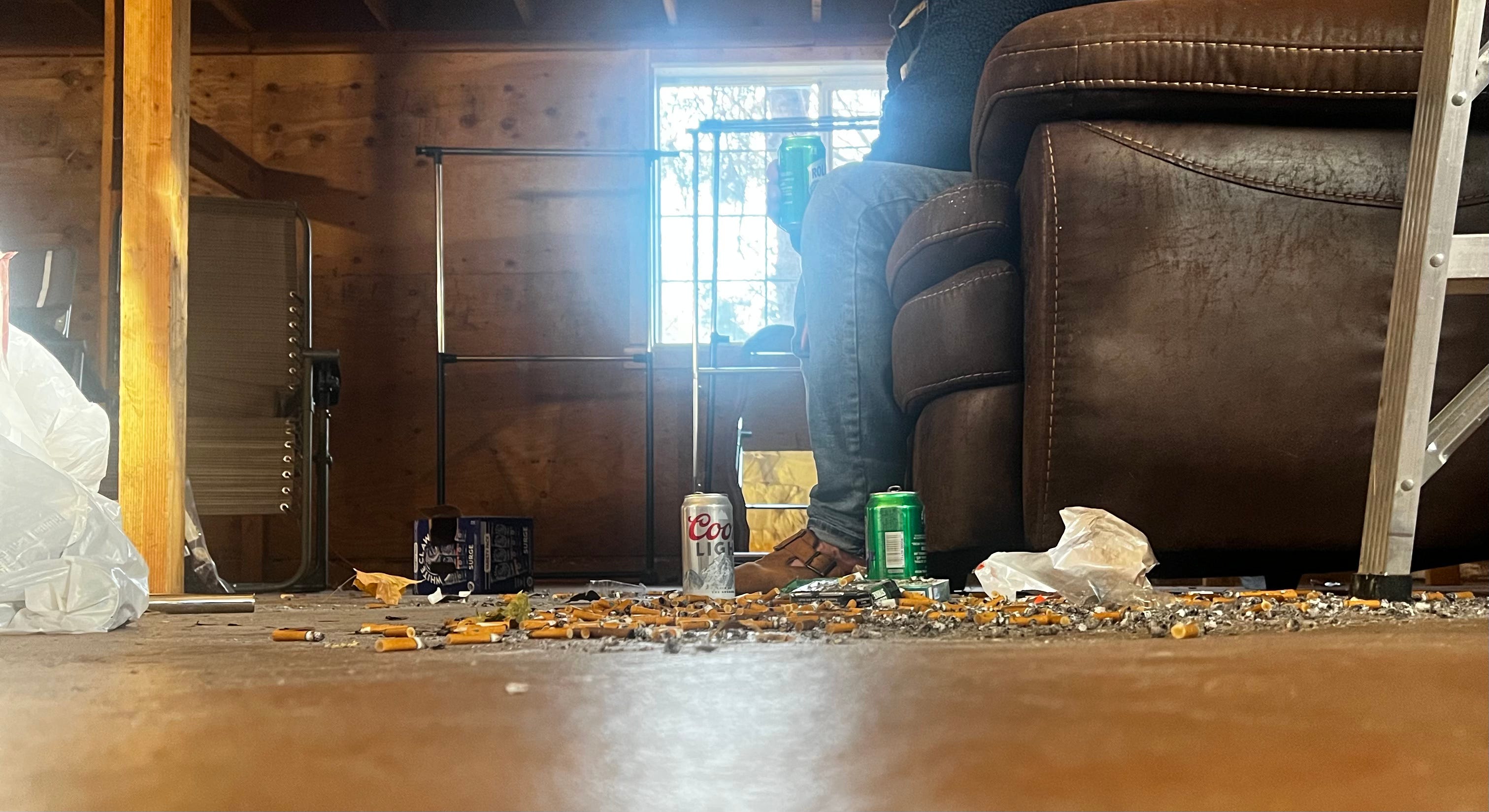
He was living in what was basically a converted barn—just a big open room with concrete floors, a loft, a small bathroom, and a kitchenette. It had heat, but the place felt cold.
He looked disheveled. Pale, like he hadn’t seen the sun in weeks. He’d grown a scraggly beard that made him look older than he was. He had gained weight in a way that made him seem uncomfortable in his own skin.
He’d adopted a cat, but hadn’t been cleaning up after it. There was cat shit in the corners. And cigarette butts—hundreds of them—scattered across the floor, crushed into the concrete like they’d been part of the foundation.
The place reeked of stale smoke. And sadness.
He was barely making it. Struggling to keep the phone and power on and a mountain of mail he didn’t have the emotional strength to open.
But I didn’t come to fix him.
I just listened.
He talked for hours. Sometimes rambling, sometimes lucid, sometimes circling in loops. I waited. And eventually, he’d say something like, “I’m lonely.”
And that’s when I’d say, “Tell me more about that.”
And for a moment, it was like he came back. The brother I remembered.
We talked about family. Mom and dad. growing up and how the move from Texas affected us so much when I was 10 and he was 19. We talked about the road trip back in the summer of 1995, when I was 15 and he was 24 and we drove there together in his old Toyota pickup. A dark blue 2 wheel drive long bed he had bought when he was 17 off the Toyota lot in North Dallas.
We shot fireworks out the window driving through Wyoming. I remember arriving in Texas and sweating through my shirt.
“What is this?” I asked.
“Humidity,” he laughed.
We talked about golf. The Cowboys. The Rangers.
Things that were easy. Things we both knew how to talk about.
I started helping him open his mail. Deal with bills. He had a tenant who was squatting in one of his units—I helped him navigate that. We worked on renting out the few spaces he still had.
It took months. But it mattered.
Not everyone in my family agreed with me. Some still keep distance. And I respect that. But for me, the cast could come off. What lay beneath wasn’t perfect—but it was healed enough to love again.
What I didn’t know—what I couldn’t have guessed—was that before I ever showed up at his door, before we sat and talked and started slowly rebuilding trust, my brother had already bought the truck.
He bought it for himself.
During one of his worst months—when his thinking was clouded, erratic, and laced with visions—he’d just sold two of his properties and had some cash. He was with a woman at the time and bought her a brand new Super White Toyota Tundra off the lot.
And while he was there, he saw another truck.
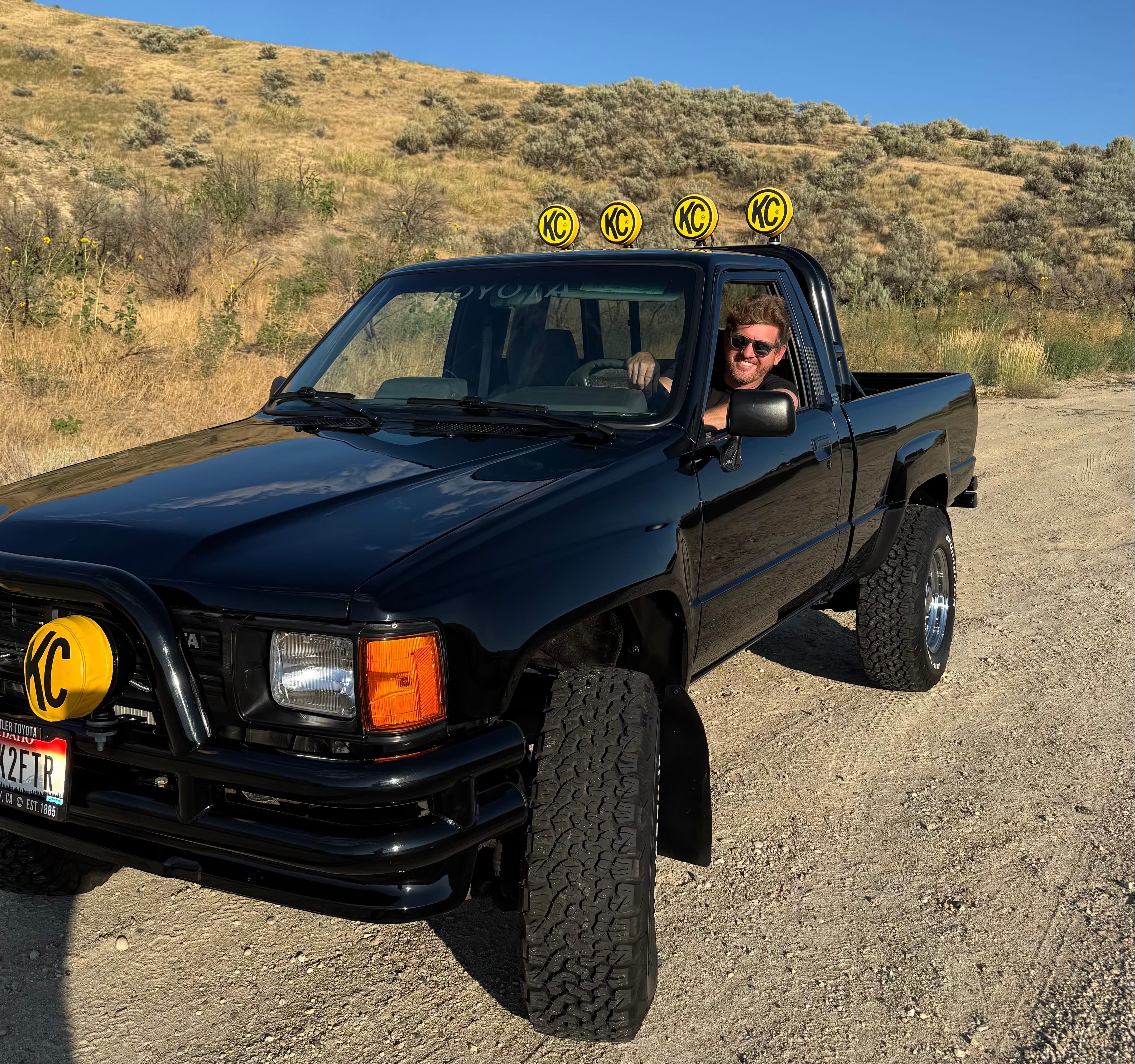
A 1987 black Toyota pickup. Four-wheel drive. Lifted. Black roll bar. KC lights.
And the thing that caught his eye: the license plate.
OUTATIME.
The same plate from the DeLorean in Back to the Future. The same one that disappears in a flash of sparks when the car hits 88.
It was a dead ringer for the one Marty McFly finds in the garage at the end of Back to the Future. That moment where everything is suddenly… better. His parents are happy. His house is clean. Biff is detailing the BMW. And sitting there in the garage, like a final wink from the universe, is that truck—cool and perfect and waiting.
That truck had lived in my imagination for decades.
In the state he was in, it must have felt prophetic. Like he was out of time. Like he was on the cusp of a breakthrough. Or maybe an escape. I never asked him exactly why he bought it. But I know it made sense to him then—in that headspace where the symbols felt real and reality was slipping.
And yet… he didn’t hold onto it.
When he came back—when the mania ebbed and some clarity returned—he must have looked at that truck and realized what it could become.
Another thing lost to neglect. Another beautiful object weathering out in the barn, untended.
So he gave it to me.
No big speech. No explanation.
Just handed me the keys and said, “I want you to have this.”
He didn’t know about the Matchbox version I’d bought months earlier.
He didn’t know the ache that came with that—how it lodged somewhere deep and stayed there.
But God did.
And that’s the part I keep coming back to.
This wasn’t about my brother.
And it wasn’t really about the truck.
And that’s the moment where I felt everything slow down.
Because sometimes, it’s not just about a truck.
It’s about being seen. Not just by a person—but by something larger.
Something that tracks. That listens. That remembers.
Something that knew, long before I did, what that truck would mean.
I have to tell you a little story that became so real to me during my separation and the haze that followed. It’s about the first Back to the Future movie, the best one really.
The Plutonium (Collateral Damage)
In the beginning, Doc has to steal plutonium from terrorists just to power the car. It’s dangerous. Chaotic. There’s a cost—nearly his life.
That was me in my twenties and thirties.
I could move forward, sure. I could build businesses, fall in love, chase big dreams.
But there was collateral damage.
Because I didn’t understand myself.
And I didn’t know how to keep from hurting the people around me.
The Lighting (Perfection)
Later, they need lightning. Marty knows it’s going to hit the clock tower at exactly 10:04 p.m. on November 12, 1955.
Everything has to be perfect—down to the second.
They devise a whole plan with cables and timing and speed.
It’s exhilarating, but exhausting. If anything goes wrong, they’re stuck.
That was the next phase of my life.
I’d seen what harm I could cause when I wasn’t careful.
So I became obsessed with precision. With perfection.
If I was going to move forward, it had to be safe.
Nobody could get hurt.
Everything had to be aligned.
But perfection is its own kind of prison.
Fusion (Flow the Tao)
Then comes that final scene.
Doc shows up again and Marty says, “Doc, you don’t have enough road to get up to 88!”
And Doc smiles:
“Where we’re going, we don’t need roads.”
He tosses garbage—banana peels, leftover beer—into this strange new reactor.
No more plutonium. No more lightning strikes. Just whatever’s left lying around.
That scene always felt like magic.
And I started to realize: maybe I’m entering that third chapter.
Maybe I don’t need everything to be perfect anymore.
Maybe I don’t have to burn through fuel that endangers myself or others.
Maybe I can move forward with ease—powered by the what ever the universe leave lying around.
What once felt like waste—grief, failure, regret—now feels like energy.
Not something to hide from, but something to use.
This was more than nostalgia.
This was revelation.
That little black truck was the embodiment of that shift.
I didn’t need plutonium.
I didn’t need lightning to strike at just the right moment.
I just needed to trust that what I had—what I already had—was enough.
When my brother handed me the keys, he had no idea what it meant.
But God, the Universe, source…. Whatever you want to call it, did.
And that’s the part I keep coming back to.
This wasn’t about my brother.
It wasn’t even about the truck.
It was about being known.
Because long before I ever got that gift, I had been guided toward it.
Not in some grand prosperity-gospel way.
But in the quiet unfolding of grace.
God had planted the desire in me.
Let it go unmet.
Let it ache.
Let it sit there dormant until the timing was right.
Then, during a season when I was re-learning how to love myself again, I started collecting Matchbox cars. That truck landed on my desk as a reminder:
“You’re allowed to want things. You’re allowed to delight.”
And then came the real one.
Given to me by a broken man in a barn full of cigarette butts and cat shit.
A man who had nothing left to give—except this.
And that’s how I knew it was love.
Because love doesn’t always come through the people who have it all together.
Sometimes it arrives through the wounded.
Through the confused.
Through the ones you thought you had to protect yourself from.
What’s even more incredible is that Korey—my brother—is still becoming more of himself.
He’s taking care of his properties again, the ones he still has.
He’s showing up for his life in new ways.
I’m not sure if he’s opening his mail yet—but he’s working on it.
He’s doing what feels right for him, with honesty and humility.
And I’ve come to see him not as someone I need to fix or manage,
but as a wonderful brother to have.
Now, I’m letting the truck go.
I’m moving into a new home with my boys—a small house that needs some work but already feels like ours.
Having a cool truck in the driveway doesn’t feel as important anymore.
What matters now is making sure we have what we need.
Comfort. Creativity. Connection.
I’ve thought a lot about what it means to release something that meant so much to me.
To pass it on.
But I don’t feel sad.
Because the truck already did what it came to do.
It reminded me of who I was.
It tied together a childhood longing, a moment of despair, a gesture of love, and a vision for the future.
It carried meaning far beyond its value.
And now it’s time for it to carry someone else.
I hope whoever ends up with it feels the same quiet magic.
Not just because it looks like Marty McFly’s truck,
but because sometimes, in this strange life,
the things we once dreamed of do find their way to us.
And sometimes the most loving thing we can do
is receive them with open hands—
and then let them go the same way.
At least he has his brothers.
💜💜💜 loved it.